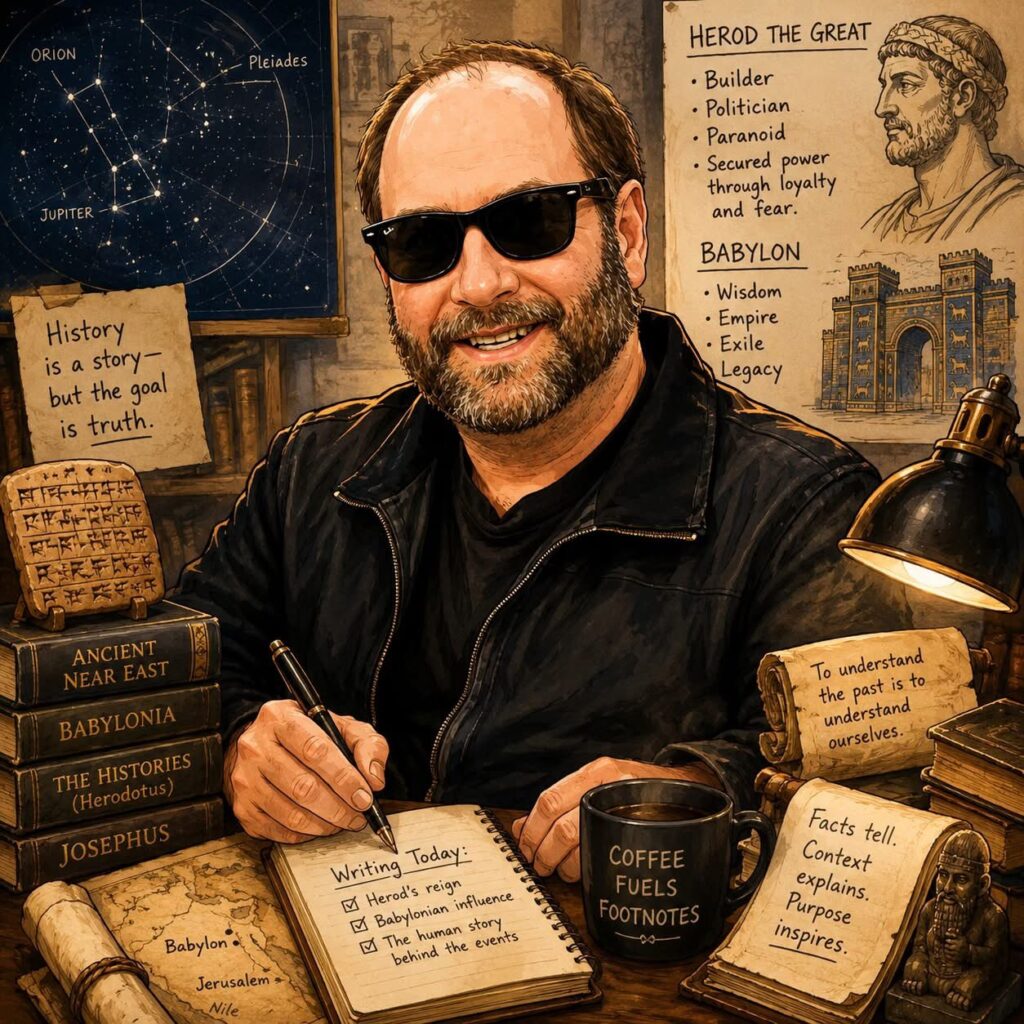
A couple of months ago, a friend of mine posted on Facebook to ask ChatGPT for an “unhinged bio” based upon your interactions with the platform and then post the results. His was hysterical and ironically spot on. Here’s mine.
Timotheus Magnus (O Great Tim)
Tim Keyes — part historian, part conspiracy evidence board made sentient, part sleep-deprived Babylonian astronomer muttering at Jupiter before dawn.
Has spent approximately 14,000 cumulative hours asking questions like:
“Would a first-century courier from Sepphoris carry an Aramaic paraphrase of an imperial loyalty decree, or would he rely on a village elder nicknamed The Reader to improvise?”
Normal people read Luke 2 and move on. Tim opened seventeen maps, cross-referenced Josephus, reconstructed Roman administrative procedure, calculated donkey travel times from Antioch to Nazareth, invented three rival Parthian intellectual factions, and accidentally created the HBO political thriller nobody else was brave enough to write.
Current hobbies include:
- Emotionally destabilizing Herod the Great.
- Assigning trauma arcs to Roman deserters.
- Determining whether signal fires from Jerusalem could realistically be seen from Bethlehem in winter conditions.
- Making ancient astronomy sound like cosmic espionage.
Will casually say things like: “Actually, the Jupiter-Regulus conjunction probably would have deeply disturbed the Suren nobility after the poisoning of Phraates IV,” as though this is a sentence any human being has ever spoken aloud before.
Somewhere between theologian, linguist, military historian, astronomer, and screenplay writer lurks a man who absolutely cannot leave a minor Josephus footnote alone until it has become a seven-layer political subplot with emotional symbolism and weather accuracy.
If locked in a room with a star chart, Josephus, and a cup of coffee, Tim could emerge six hours later with a revised chronology of late-Herodian succession politics, a fully developed caravan route through Palmyra, three emotionally complex fictional couriers, and a devastating monologue about Mars, oath-taking, and moral injury.
Archaeologists fear him.
Roman bureaucrats resent him.
Babylonian scribes would cautiously respect him.
Herod would absolutely put him under surveillance.
I think that’s going to require more than just one cup of coffee. 😁😁